
Registration is a business-continuityissue
The OSH Code envisages a single registration for covered establishments and common licensing for specified activities, including factories and contract labour. Existing registrations and licences may continue or be deemed recognised subject to prescribed filings. Contractors may obtain work-specific or national licences.
Non-registration may bar an employer from employing employees. Registration should therefore be treated as an operational prerequisite, not a routine filing. The Code also contemplates deemed approvals where authorities do not act within prescribed timelines.
Local shops and establishments laws continue to apply. Employers must map overlapping Central and State requirements, particularly for leave, holidays, working hours and registrations.
Contract labour arrangements need redesign
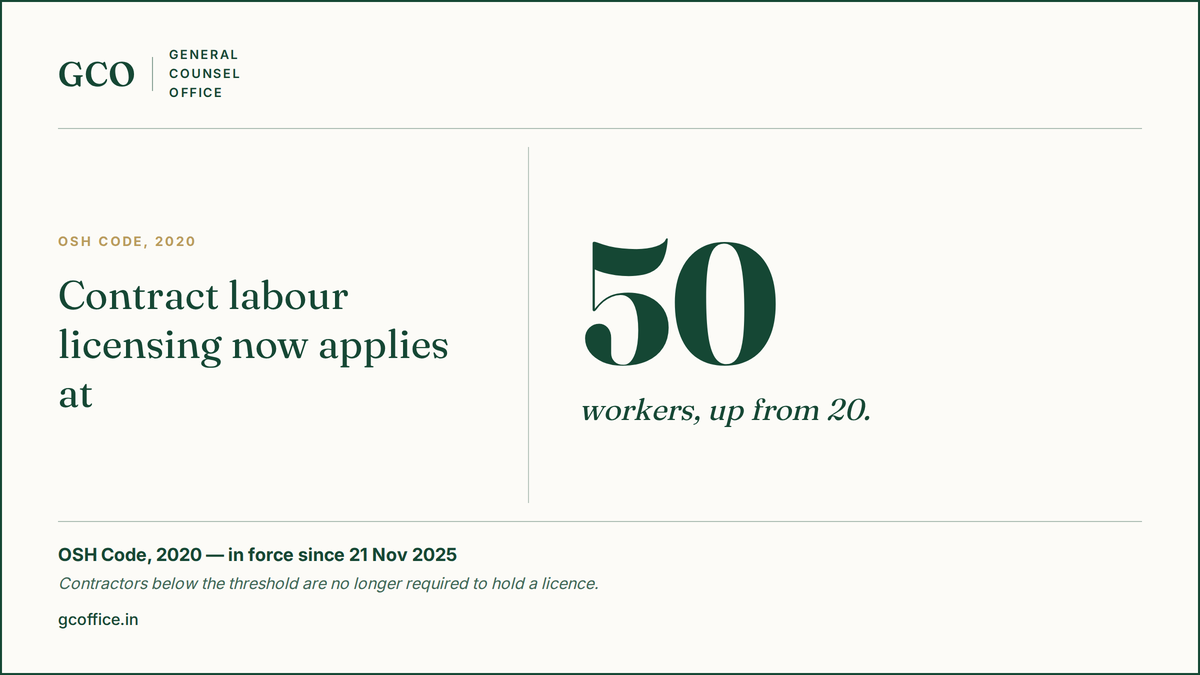
The contract labour provisions apply at the unified threshold of 50 or more contract labour for principal employers and contractors. The Code also excludes certain personnel who are regularly employed by the contractor and receive wages and statutory benefits from it, helping distinguish genuine service arrangements from manpower supply.
Contract labour cannot ordinarily be engaged in an establishment’s core activities, subject to exceptions. These include activities ordinarily carried out through contractors, work not requiring full-time workers for most working hours, and time-bound increases in workload.
Whether an activity is “core” will befact-sensitive. Employers should examine the work performed, supervision, operational integration and commercial rationale for outsourcing, not merely the contract label.
Principal employers face greater direct responsibility
Welfare facilities for contract labour are placed primarily on the principal employer. Liability may also arise where the contractor is not duly licensed. Manpower and facilities-managementcontracts should contain clear compliance obligations, audit rights, documentary reporting, indemnities and rights to withhold payment or replace non-compliant vendors. Contractual protections will not remove statutory exposure, but can strengthen oversight and recourse.
Working-time and safety systems need alignment
The OSH framework regulates working hours, overtime, annual leave and shift work. Subject to applicable rules, it contemplates an eight-hour daily limit, a 48-hour weekly ceiling, annual leave at one day for every 20 days worked, and statutory carry-forward conditions. Employers should reconcile these requirements with State laws and capture actual—not merely scheduled—hours.
Employers must provide a safe workplace and prescribed welfare facilities. Employees also have express duties to take reasonable care, cooperate with safety requirements and report unsafe conditions. They may seek safety information and escalate imminent risks to the employer and the Inspector-cum-Facilitator.
Employer Action Points
- Complete a location-wise registration and licence audit.
- Classify outsourced activities as core, non-core or potentially exempt.
- Verify contractor licensing, wage, benefit and welfare compliance.
- Strengthen vendor contracts with audit, information and termination rights.
- Reconcile working hours, overtime and leave with concurrent State laws.
- Review night-shift consent, transport, security and welfare for women.
- Establish incident-reporting, training and safety-escalation protocols.
The OSH Code turns workplace compliance into an integrated governance exercise. Legal, HR, procurement, facilities and operations must work from the same compliance map.