
THE LABOUR CODES IN PRACTICE | A Four-Part Blog Series for Employers
IN THIS SERIES
- Article 1 of 4 The Code on Wages: What Employers Must Revisit in Payroll, Benefits and Employment Contracts
- Article 2 of 4 The Industrial Relations Code: Restructuring, Standing Orders and Collective Workforce Relations
- Article 3 of 4 The OSH Code: Licensing, Contract Labour and Workplace Accountability
- Article 4 of 4 The Social Security Code: PF, ESI, Gratuity and the Changing Workforce
ARTICLE 1 OF 4 | The Code on Wages: What Employers Must Revisit in Payroll, Benefits and Employment Contracts
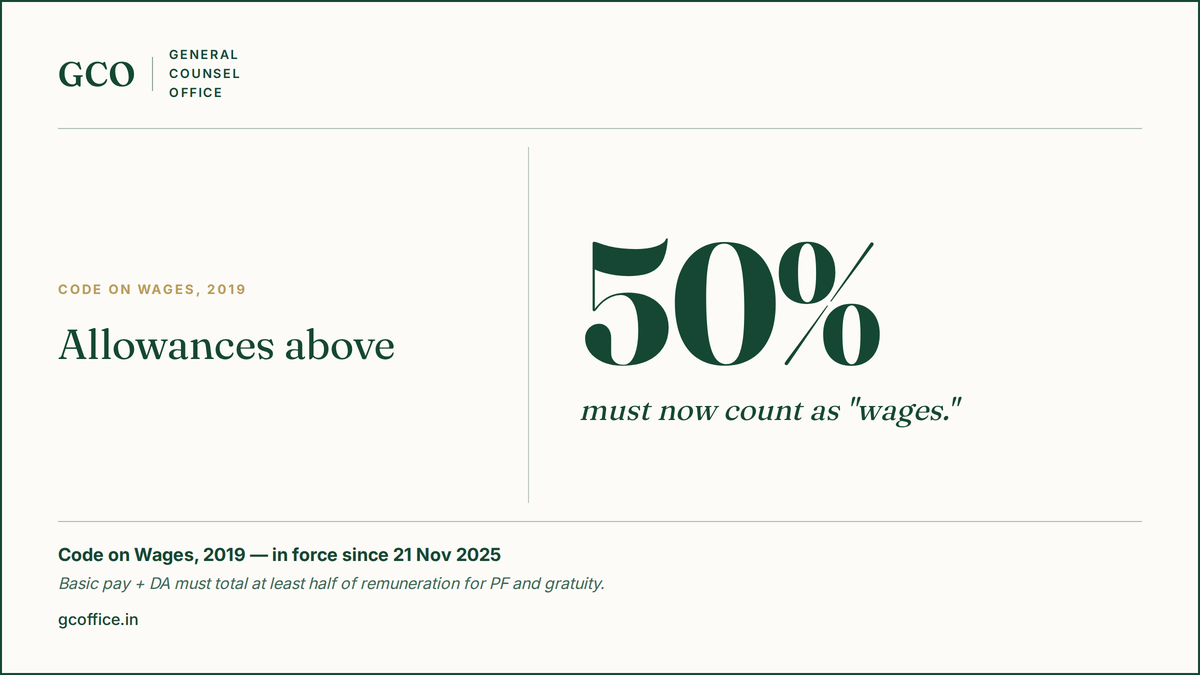
The 50% rule changes the cost base
The new definition of “wages” is the immediate compliance issue. Components such as house rent allowance, conveyance allowance, overtime allowance and employer provident fund contributions are excluded, but the exclusions cannot collectively exceed 50% of total remuneration. Any excess is added back to wages. Remuneration in kind may also be included up to the statutory limit.
Wages are the base for gratuity, retrenchment compensation, notice pay, leave encashment and social security contributions. Salary structures that historically kept basic pay low and allowances high may therefore produce a materially higher statutory cost.
Minimum wage protection is now universal
The earlier concept of “scheduled employment” has been removed. Minimum wage provisions now apply across employment and to all employees. The Central Government may prescribe a floor wage based on living standards and geography, below which the appropriate Government cannot fix minimum wages. Multi-State employers must track both rates and apply the higher one.
Payment protections extend to senior management
Unlike the earlier Payment of Wages Act, the Wage Code does not limit payment-of-wages protections by salary level. Payment timelines, restrictions on deductions and statutory remedies now extend to all employees, including managerial and senior personnel.
Employers should revisit delayedfull-and-final settlements, adjustment of disputed sums, recovery of joining bonuses, clawback of severance or retention payments, and deductions for notice-period shortfall. A contractual right to recover an amount does not automatically make a payroll deduction permissible.
Bonus and pay parity require wider review
The statutory bonus eligibility threshold is to be prescribed by the appropriate Government. Until changed, employers should maintain existing coverage for employees earning up to INR 21,000 per month. Different State thresholds could complicate national compliance. Termination for sexual harassment is also an additional ground for disqualification from the statutory bonus.
The Wage Code prohibits discrimination in remuneration on the ground of gender. Equal pay for the same or similar work must be assessed using objective factors such as skill, effort, experience and responsibility. Employers should test both compensation structures and job classification practices.
Employer Action Points
- Model the financial impact of the 50% rule across employee categories.
- Review salary structures, offer letters, bonus plans and separation templates.
- Audit payroll deductions and clawback mechanisms for statutory permissibility.
- Map minimum wages and floor-wage notifications by location.
- Conduct a gender pay and job-comparability review.
- Build a process to update payroll when Central or State thresholds change.
The Wage Code is not merely a payroll reform. It requires compensation design, employee documentation, and exit practices to be aligned with a common statutory definition affecting the entire employment lifecycle.